My experiences in the artic region left a sour taste in my spirit. The footprints of man are omnipresent, and nature is retreating at high speed. The ice disappearing, wildlife is threatened and scares…
Scientific information and media news alert with apocalyptic predictions. And what our eyes see and the spirit feels is not encouraging.
Audrey Benedict – Director of Cloud Ridge Naturalist and essentially sensitive soul- wrote after her recently trip to the artic region:
My experiences in the artic region left a sour taste in my spirit. The footprints of man are omnipresent, and nature is retreating at high speed. The ice disappearing, wildlife is threatened and scares…
Scientific information and media news alert with apocalyptic predictions. And what our eyes see and the spirit feels is not encouraging.
Audrey Benedict – Director of Cloud Ridge Naturalist and essentially sensitive soul- wrote after her recently trip to the artic region: 
“…The trip to the Russian Arctic and Siberia was devastating to me in terms of facing the harsh realities and accelerating pace of "the end of nature" (to quote Bill McKibben) as we know it in all Polar Regions--HEAD-ON! Yes, of course, seeing the scenery and so many tundra wildflowers, as well as the extraordinary seabird nesting cliffs, was a wonderful experience overall. But, then there was the dark, omnipresent cloud of environmental decay and destruction everywhere we went. We are, in my view, well over the environmental "tipping point" where the impacts of global warming are concerned. Seeing evidence everywhere of the incredible rate at which permafrost is melting on land and beneath the sea floor (and the associated release of methane gas) and what this truly means for future climate makes worrying about carbon footprints seem almost ludicrous. Couple this with witnessing several polar bears swimming to their inevitable deaths (already 90 km offshore) in what could only be a desperate search for sea ice and food left me almost paralyzed and emotionally drained. I will never, ever forget looking into the eyes of the last polar bear I saw swimming northward. Though I've never felt that what I do is "Ecotourism" in the traditional sense--I've also NEVER felt, as I did this time, that I'd grossly misrepresented to people what they could expect to experience and see on a trip. How do you”market" a trip to see suicidal polar bears and seabird rookeries where there has been NO successful reproduction because there were NO fish to be caught? I haven't even been able to download the pictures I took on the trip--I see every image too vividly in my mind. I even wrestle with what to tell my grandchildren. The truth, of course, but how will I frame it for them?”
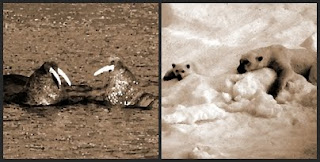
My thoughts remain fixed on to the eyes of the polar bear of her description: “…I will never, ever forget looking into the eyes of the last polar bear I saw swimming northward…” That paragraph reflects the agony of the Artic. I can reproduce the moment without any effort in my mind, and feel what she feels. Also I am begging to imagine what the bear feels… While writing I saw myself surrounded by endless open sea waters. No trace of ice, only water. At the distance a tiny white spot getting bigger and bigger as the ship get closer to it. The distance that separate the white spot – the polar bear- to the ship is shorter enough to see the bear’s head. Like with a powerful zooming our eyes get in contact. For a few seconds we looked each other. Suddenly –like if the bear knows- he focuses his sight to the distance, straight ahead, to the far horizon. I do the same hoping to catch a glimpse of the elusive ice. My mind –again like other countless times- reproduce images from the other side of the world: the Antarctic. Down there things are not much different. There are no polar bears. Artic comes from the Greek “Arctos”, Land of the Bear. Antarctica is the opposite; and -like every opposite- it’s bursting with life. No polar bears but millions of penguins of different species, seals, sea lions, elephant seals, whales and myriads of sea birds… not many humans. It seems like Antarctica is a paradise. Nevertheless, slowly but steady, nature claims for attention. The ice cap is melting. Temperature is rising. Penguins decline in number. Krill –as the main food resource is harvested…
 Human presences provoke disturbances. Ecotourism increase its impact… Nowadays there are no more Macaroni Penguins in Hanna Point, and you can notice the erosion and declined of the colonies of Gentoos, and Chinstraps caused for thousands of visitors every season. Despite regulations, it is possible to find seven –yes 7- ships inside the caldera of Deception Island at the same time. There are more examples: accidents caused by ships, oil spills, grounded or sunk vessels.
There are numbers, scientific statistics and premonitions.
Same picture in both extremes.
Again the vivid images seen by Audrey break into my mind.
The ship –like the polar bear- head north. I can’t take my eyes away from the bear’s eyes. Our eyes make contact and I can see its resolution and hope. In the end the bear not thinks, instinctively he only swims, living the moment, hopping for the ice, for food… Suddenly I understand:
Human presences provoke disturbances. Ecotourism increase its impact… Nowadays there are no more Macaroni Penguins in Hanna Point, and you can notice the erosion and declined of the colonies of Gentoos, and Chinstraps caused for thousands of visitors every season. Despite regulations, it is possible to find seven –yes 7- ships inside the caldera of Deception Island at the same time. There are more examples: accidents caused by ships, oil spills, grounded or sunk vessels.
There are numbers, scientific statistics and premonitions.
Same picture in both extremes.
Again the vivid images seen by Audrey break into my mind.
The ship –like the polar bear- head north. I can’t take my eyes away from the bear’s eyes. Our eyes make contact and I can see its resolution and hope. In the end the bear not thinks, instinctively he only swims, living the moment, hopping for the ice, for food… Suddenly I understand:
- Dear brother – I whisper to the polar bear- we, like you, are also living the moment, ignoring the future. Following the same path, hoping innocently that everything is going to be fine, here or who knows where. We, like you, are immortals. ¿Are we?


 Brown-hooded gull (Larus maculipennis)
These small gulls molt into breeding plumage this month. Sometimes they look a lot like terns when they are flying; they have bright red legs and feet and feed on the “restingas” at low tide.
Brown-hooded gull (Larus maculipennis)
These small gulls molt into breeding plumage this month. Sometimes they look a lot like terns when they are flying; they have bright red legs and feet and feed on the “restingas” at low tide.  Crested Duck (Anas specularoides)
This large duck has got its common English name for a crest which is not quite so, as it is on the back neck, so it is not very visible, unless you get very good looks of the head. They live in salty or fresh water and are wide spread in Argentina and Chile. They have a large green iridescent patch on their wings which is visible in flight, and it is after this patch that they were given the Latin name specularoides.
Crested Duck (Anas specularoides)
This large duck has got its common English name for a crest which is not quite so, as it is on the back neck, so it is not very visible, unless you get very good looks of the head. They live in salty or fresh water and are wide spread in Argentina and Chile. They have a large green iridescent patch on their wings which is visible in flight, and it is after this patch that they were given the Latin name specularoides.  Two-banded Plover (Charadius falklandicus)
A flock of 20 or 30 plovers with breeding and non breeding plumage were feeding at low tide, on the “restingas” (rocky platforms with small mussels, barnacles, tidal pools with anemones, snails & worms) near Cerro Avanzado. When I downloaded the photos I realized several were banded so I sent the information to the local researchers. They run a few meters and stop while they are feeding, they love eating a worm which is so big compared to their size, you wonder where the fit it in! They migrate within Argentina, and are strictly a South American shorebird. Other birds who were sharing the food available were Kelp Gulls and Blackish Oystercatchers.
Two-banded Plover (Charadius falklandicus)
A flock of 20 or 30 plovers with breeding and non breeding plumage were feeding at low tide, on the “restingas” (rocky platforms with small mussels, barnacles, tidal pools with anemones, snails & worms) near Cerro Avanzado. When I downloaded the photos I realized several were banded so I sent the information to the local researchers. They run a few meters and stop while they are feeding, they love eating a worm which is so big compared to their size, you wonder where the fit it in! They migrate within Argentina, and are strictly a South American shorebird. Other birds who were sharing the food available were Kelp Gulls and Blackish Oystercatchers.  Some flocks of wild geese have been flying South, the most common is the Upland Goose. The few land birds I saw were mostly Rufous–collared Sparrows, the always happy singer the Patagonian Mockingbird, and the gorgeous looking Long –tailed Meadowlark. This last bird is one of the few with Red coloration we have the pleasure to spot on the vast desert.
  September is when the Magellanic penguins return to nest at the several colonies along the Coast of Patagonia. Keep on checking our blog with further news on penguins.


 When in the chaos of daily life, a word, a phrase read in the newspaper, news seen on television, mentions her no matter where we are. From any corner of the planet, those who stepped on Antarctica, will feel that only one cardinal point rules their compass and will not -nor will be able to- avoid the spirit to escape free and wild to join the colossal score of voices, sounds, shapes and colors in that remote Antarctic last frontier. ..”


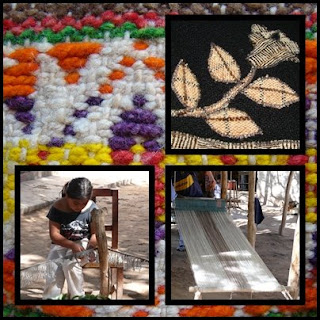 We focus on 2 very different areas: the Argentine Northwest, with several strong influences in their textiles. And Patagonia, where the “mapuches” spin not as fine, and weave with no foreign influences, taught from mothers and grandmothers to only the women in the family. We'll also visit some fine Museums. Our tour leader will hold a mini-class in the hotel, teaching how to spin with a mapuche spindle.
Our trips incorporate unique talks, demonstrations, visits with people who have used ancient techniques in their art, Join us to share lively dinner table conversations and a great give and take along the way.
We focus on 2 very different areas: the Argentine Northwest, with several strong influences in their textiles. And Patagonia, where the “mapuches” spin not as fine, and weave with no foreign influences, taught from mothers and grandmothers to only the women in the family. We'll also visit some fine Museums. Our tour leader will hold a mini-class in the hotel, teaching how to spin with a mapuche spindle.
Our trips incorporate unique talks, demonstrations, visits with people who have used ancient techniques in their art, Join us to share lively dinner table conversations and a great give and take along the way.