April 12, 2011

HIGHLIGHT SEASON 2010/11

Darwin, Textiles, Ice and Wildlife

Especially designed custom trips make a “whale” of a season for Carol and me.
Enjoyable, diverse, thematic, intense, and rewarding -not only for us or our travelers-
but for all the people who gave us their services, hospitality and knowledge at every place we visit…
And believe me; some were far beyond of the beaten path.
Enjoy our photographic report.

Weaving Andean Stories (October 15-30, 2010)
Tracing Argentina's Cultural Heritage and Textiles
 
Learning from mapuche artisans in Gualjaina - Patagonia

Local mapuche artisan

Piedra Parada - Patagonian steppe

A genuine vicuña scarf must pass through a ring Jujuy Northwest Argentina

Landscape at Quebrada de Humahuaca - Jujuy Northwest Argentina

Mapuche designs - Patagonia

Cloud Ridge Director learning textile techniques

  The textile group enjoying pristine landscapes
 
2011 Tours - OCTOBER 21st to NOVEMBER 4th - Small group departure, limited space still available
NOVEMBER 13th to NOVEMBER 27th Cloud Ridge Naturalist Private Tour

Enjoy and learn with Carol and native artisans from NorthWest and SouthWest Argentina our rich cultural heritage!
 
(Next -Darwin Footstepes I)

August 25, 2010

Causana's New Web

Live Life…


Causana’s new web site is published: www.causana.com


Thirty years ago we adopted Patagonia as our home. All those years we have actively worked in tourism and nature conservation. At the beginning as park ranger and tour guides -later, the second half (fifteen years)- through Causana Viajes, emphasizing the practices of ecotourism and responsible tourism as principal objective.


We are proud of that because -not without effort- so far we have “survived” and maintain our philosophy by doing what we know. Work as we feel we have to work: giving quality, knowledge, and rewarding experiences. Economic facts are important, but for true travelers, the experience is what matters most.


Young people who were trained by us started to work as guides and tour leaders. Today we have a selected team who work with us; some of them out in the field, and others at the office.


We invite you to travel with us discovering and exploring the vast and diverse southern portion of South America: The mystery and solitude of Patagonia, the rough seas and mighty Andes Mountains, giant glaciers, endless steppes. To the north, the chromatic color of the Atacama Desert, the high plateau of the Puna; or the powerful waters of Iguazu Falls, and exuberance of the dense subtropical forest. Leaving mainland the exotic mystery of Eastern Island, awaits to mesmerize you with the incognita of ancient civilization. Or across the rough Drake Passage the incomparable visit to Antarctica, the last continent… In this incomparable scenery –like actors on stage-, the presence of unusual wildlife interacting for centuries with man and his culture, enrich your whole travel experience...


More than 25 years of traveling give us the right to say we know our land, and testimony of our passengers –some of them who traveled more than five times with us- emphasize that.


See our programs and select your next adventure to the end of the world.


We await your visit!

July 26, 2010

Walking with Whales II

Hearing the whales

“Long time ago I read, in an article from an old natural history magazine, that Inuits –in the Arctic- have a place were they go “to hear the whales…” Seated on the pebble beach -located only a few kilometers from the city of Puerto Madryn, in Patagonia- I remembered that article and smiled grateful. The Southern Right Whales swim in front of me only a few meters from the coast. I can see their evolutions, their behavior, hear their voices and –also occasionally- smell their breath…”
(From Dinosaurios “Relatos y Sueños de un Guardafauna by Carlos A. Passera) Walking with Whales
Walking with Whales Last year I wrote in this blog a post called “Walking with Whales”. Again I feel the need to share a bit of that incredible experience of being so intimate with the whales. Nothing, photos or descriptions, can explain the privilege of that incomparable rendezvous with them. But let me try again. Walking with Whales Since April to end of October we go almost every day to the beach called El Doradillo –distant only 17 kilometers from the city of Puerto Madryn- to enjoy the gentle giants: the Southern Right Whales. Year after year the feelings are the same: astonishment, fascination, harmony and gratitude… Even though we are enormouslly privileged to rise every morning and see the whales through the window of our home in the city, and spy them at any time during the day on our way to the bank or doing shopping or driving to work, going to El Doradillo is a balsam.
Walking with Whales Walking with Whales Walking with Whales Walking with Whales
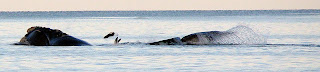
Not one or two whales living freely their lives, no, dozens of them pass by in front of the people, no further than 5 to 10 meters from the shore. Nursing their calves, mating, breaching, lob tailing, doing –not more and surely not less- than living their own life.
Walking with Whales Walking with Whales Walking with Whales Enjoy the photographs.
Carlos & Carol Passera Photos: Carlos & Carol Whale season at Peninsula Valdes: End of April to end of November; At El Doradillo area and from Puerto Madryn waterfront end of April to end of September.

July 22, 2010

PEREGRINE Falcon

Our visitor

This years regular visitor is a young Peregrine falcon, in this picture we took from our window 10 days ago, you can see it is already molting to adult plumage. Peregrine falcons are sexually mature at the end of their first year of life but they tend to reproduce between the age of two and three. The male courtship flight consists of flying in a series of spirals forming an eight shape and he offers his female prey as a gift. They mate for life and return to the same nest year after year. It nests on shelves on cliffs; lay between 2 and 4 creamy colored eggs. The female incubates the eggs for a month; the male provides the female and chicks with food.

I have watched a peregrine falcon attack and eat a Crested Duck but the one nesting near Puerto Madryn feed on seabirds, such as South American Terns and Rock Doves which abound in the city. This bird likes to perch on the corner of our terrace and we feel our heart stop when we are lucky enough to be at home when it does stop by. We also want to share the beautiful sunset and moons we get to see from our home. Carol & Carlos Passera

June 28, 2010

NEW OLD CAUSANA

RELOADED
After a few months of doubtful introspection we return to our communication through our blog. The world wide economic debacle changed many things. Traveler’s ways of choosing their trips too… We tried hard to adapt our travel offers to the situation, but in many cases that meant less quality. Disappointed with the general panorama, the politicians point of view (massive tourism in the natural areas), and greedy behavior of colleagues, we took time to re-think our idea of working with tourism.
Our new web site reflects some of that, but essentially we decided to do what we know. Work as we feel we have to work: giving quality, knowledge, and rewarding experiences. Economic facts are important, but for true travelers, the experience is what matters most. A recent trip to Mongolia –probably the last free land on earth- inspired us to go deeper in our way of designing our travel programs. Beyond the unbeaten path there is a different Argentina. Culture, landscapes, people, colors, smells, nature, wildlife… All is there waiting for the avid true traveler.
Practicing Responsible Tourism is our goal, and our next October trip “Weaving Andean History” an example of the New-Old way of travel for Causana Viajes. Especially designed by Carol, for our old friend Audrey Benedict from Cloud Ridge Naturalists, the trip emphasizes in the ancient weaving tradition of Argentina. The trip roams from the Northwest to Patagonia, learning the different techniques of each region. The Inca influence at the North and the Tehuelche and Mapuche aborigine practice in the South. The voyage visits little towns, textile cooperatives, some of them way out of the touristy routes, and takes a look at the new mixture between designers who use the ancient techniques for new fashion models.
With your help we want to repeat this travel experience every year to help people of the communities. This and others trips are waiting for you. Until our new web site is finished, we update you through our blog. Carol & Carlos

December 3, 2009

BIRDS of ARGENTINA

Burrowing Parrot

They frequent open fields or bush covered steppe in small flocks that search for fruits, seeds and tender sprouts on trees, bushes and on the ground. They make short low flights while feeding. There always is a bird “on watch” while the others feed, sometimes they feed on corn or wheat causing loses in the crops. Burrowing Parrots travels extensively in search of food. When it is returning to their roosting sites they fly high, and are very noisy.

They form colonies, dig the long burrows in which they nest, some being a meter in length. These burrows are usually found on cliffs of creeks, rivers or sea shores. Some pairs mate for life. They lay 2-4 white eggs which they incubate for 20 days. They gather to sit on telephone wires, posts and exposed branches at top of trees. They have been heavily combated as a pest or captured to be sold as cage birds.

The species of Patagonia is believed to be different to the one in the North West of Argentina, and different to the one in Chile. They are probably 3 subspecies.Consult to come and enjoy us!!!
Carol Mackie -
(Photos - Berna Urtubey - Carol Mackie - Carlos Passera)

November 4, 2009

COMMITMENT WITH NATURE

Good News from the Directors desk
Causana Viajes has always believed in sharing profits with conservation projects, has obtained important land donations for local ONG’s, and at our initial years even helped form a local ONG that works protecting, researching and education about the Patagonian coastal orcas. Through our 13 years of existence we have employed as many local people as possible, formed guides and tour leaders. This is one of the principles of Ecotourism, or sustainable tourism we have been able to fulfill. I am happy to announce that in 2009 we decided that the funds obtained in the year 2008 for this purpose would have a new destination. The idea is EDUCATION. To educate travelers and locals equally by publishing books, pocket fieldguides and even our new blog.
Today I am pleased to announce the book DINOSAURIOS, Relatos y sueños de un Guardafauana by Carlos A. Passera. The first part of the book is stories about the Passera’s family experiences at Punta Tombo and the years Carlos was a “guardafauna” (Park Ranger) at this immense penguin colony. The second part is about Carlos’s dreams of what he would like to happen to the Nature Reserve of the province of Chubut in the near future. His goal with this book is to create debates and forums of discussion and why not waken some of the dormant authorities. This province was a pioneer in conservation in Latin America in the 1960’s and we wish it would remain that way so Carlos is trying to shake us all and waken us while we read his second part of the book. The Fundación Patagonia Natural (FPN), The Fundación Vida Silvestre Argentina (FVSA), the Instituto de Enseñanaza Superior (IDES) and Causana Viajes recommend the reading of DINOSAURIOS . The author of the book ilustrations is Juan Carlos De Souza, a young voluntier from Fundación Vida Silvestre Argentina, and now an Agronomist Engineer. The title of the book comes from a conversation Carlos’s had with a colleague many years ago while they were on assignment writing an article for a BA magazine. His Friend “the Negro Acosta” said to Carlos: - “ You are a dinosaur”, - What? – Carlos asked. - “Yes, you and the “fat guy of the whales”, and so many others that look for the last pure corners of the Earth, are DINOSAURS. You are condemned to extinction because you dream about an ideal world that languishes. Practice your Spanish so you friends, who care about nature like we do, can read this book and participate in the debate. Carol Mackie de Passera

September 29, 2009

Polar Experiences

The Eyes of the Bear
by Carlos A. Passera
My experiences in the artic region left a sour taste in my spirit. The footprints of man are omnipresent, and nature is retreating at high speed. The ice disappearing, wildlife is threatened and scares… Scientific information and media news alert with apocalyptic predictions. And what our eyes see and the spirit feels is not encouraging. Audrey Benedict – Director of Cloud Ridge Naturalist and essentially sensitive soul- wrote after her recently trip to the artic region:

“…The trip to the Russian Arctic and Siberia was devastating to me in terms of facing the harsh realities and accelerating pace of "the end of nature" (to quote Bill McKibben) as we know it in all Polar Regions--HEAD-ON! Yes, of course, seeing the scenery and so many tundra wildflowers, as well as the extraordinary seabird nesting cliffs, was a wonderful experience overall. But, then there was the dark, omnipresent cloud of environmental decay and destruction everywhere we went. We are, in my view, well over the environmental "tipping point" where the impacts of global warming are concerned. Seeing evidence everywhere of the incredible rate at which permafrost is melting on land and beneath the sea floor (and the associated release of methane gas) and what this truly means for future climate makes worrying about carbon footprints seem almost ludicrous. Couple this with witnessing several polar bears swimming to their inevitable deaths (already 90 km offshore) in what could only be a desperate search for sea ice and food left me almost paralyzed and emotionally drained. I will never, ever forget looking into the eyes of the last polar bear I saw swimming northward. Though I've never felt that what I do is "Ecotourism" in the traditional sense--I've also NEVER felt, as I did this time, that I'd grossly misrepresented to people what they could expect to experience and see on a trip. How do you”market" a trip to see suicidal polar bears and seabird rookeries where there has been NO successful reproduction because there were NO fish to be caught? I haven't even been able to download the pictures I took on the trip--I see every image too vividly in my mind. I even wrestle with what to tell my grandchildren. The truth, of course, but how will I frame it for them?”
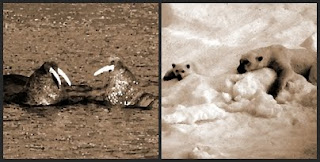
My thoughts remain fixed on to the eyes of the polar bear of her description: “…I will never, ever forget looking into the eyes of the last polar bear I saw swimming northward…” That paragraph reflects the agony of the Artic. I can reproduce the moment without any effort in my mind, and feel what she feels. Also I am begging to imagine what the bear feels… While writing I saw myself surrounded by endless open sea waters. No trace of ice, only water. At the distance a tiny white spot getting bigger and bigger as the ship get closer to it. The distance that separate the white spot – the polar bear- to the ship is shorter enough to see the bear’s head. Like with a powerful zooming our eyes get in contact. For a few seconds we looked each other. Suddenly –like if the bear knows- he focuses his sight to the distance, straight ahead, to the far horizon. I do the same hoping to catch a glimpse of the elusive ice. My mind –again like other countless times- reproduce images from the other side of the world: the Antarctic. Down there things are not much different. There are no polar bears. Artic comes from the Greek “Arctos”, Land of the Bear. Antarctica is the opposite; and -like every opposite- it’s bursting with life. No polar bears but millions of penguins of different species, seals, sea lions, elephant seals, whales and myriads of sea birds… not many humans. It seems like Antarctica is a paradise. Nevertheless, slowly but steady, nature claims for attention. The ice cap is melting. Temperature is rising. Penguins decline in number. Krill –as the main food resource is harvested…

Human presences provoke disturbances. Ecotourism increase its impact… Nowadays there are no more Macaroni Penguins in Hanna Point, and you can notice the erosion and declined of the colonies of Gentoos, and Chinstraps caused for thousands of visitors every season. Despite regulations, it is possible to find seven –yes 7- ships inside the caldera of Deception Island at the same time. There are more examples: accidents caused by ships, oil spills, grounded or sunk vessels. There are numbers, scientific statistics and premonitions. Same picture in both extremes. Again the vivid images seen by Audrey break into my mind. The ship –like the polar bear- head north. I can’t take my eyes away from the bear’s eyes. Our eyes make contact and I can see its resolution and hope. In the end the bear not thinks, instinctively he only swims, living the moment, hopping for the ice, for food… Suddenly I understand:

- Dear brother – I whisper to the polar bear- we, like you, are also living the moment, ignoring the future. Following the same path, hoping innocently that everything is going to be fine, here or who knows where. We, like you, are immortals. ¿Are we?

GIVING WINGS TODAY FOR TOMORROW Carol – Causana’s Viajes Director- truly enjoys birdwatching. And part of the fun is teaching kids how find, recognize and protect them. Last Monday Carol faced, with determination, the not easy task of being in front of 50 noisy, energetic and curious kids of 5 to 6 years old. The challenge was high; Francisco –Carol’s grandchild- was part of the gang. And of course he observes his Granny with special attention and rigorous criticism.
She passed the test.
The kids enjoyed the photographs, her explanations about the most common birds that they can watch every day in their backyards, close to the beach, on the trees or at the nearby pond. Every one participated with enthusiasm and happiness touching the feathers of the flamingoes, rheas, tinamous, and opening big eyes looking mesmerized at the size of a Condor feather.
Birds and kids are all over the world. If we gave them the opportunity to know, understand and respect the natural world and all its creatures, probably all of us will have the chance to build a better world.
Enjoy the photographs!